
Herb of the month July: yarrow
Yarrow
Achillea millefolium
It took me a minute to think about what ONE plant to highlight this month. This is when things really come alive which brings so much medicine into our lives. However, once I got out of my head and stepped outside and saw the abundance of Yarrow both in the field of my home and in the garden, I knew it was meant to be. Have you ever heard of or used this plant? Many call it a “common weed”. Pay attention if it is present on your property and see if any of the indications ring true to you or someone who lives with you.
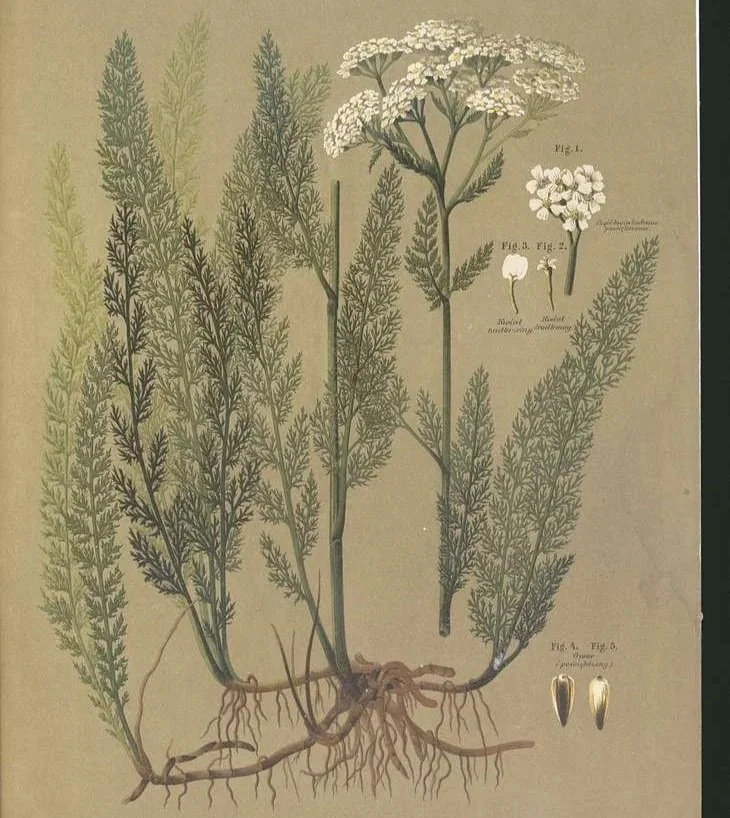
Yarrow is best recognized by its creamy white flowers that bloom in dense, flat top clusters. The leaves are feathery soft and look similar to lace.
This plant is commonly found scattered around fields as a perennial plant. Ornamental versions are sold as seed to plant in gardens that can be pink or yellow in color.
Many plants have a Doctrine of Signatures which indicate what they are best used for. The leaves of yarrow can be compared to the look of small capillaries in the body, indicating support of blood regulation.
Yarrow is considered the great harmonizer and master of the blood. Summer highlights our heart/circulatory system and small intestine as the organs to support the most, meaning this is one of the perfect herbs for the season.
Yarrow in a mild tea is slightly bitter making it wonderful to have 30 minutes prior to a meal to support the liver in secreting bile for digestion. This same tea taken in the evening is helpful to wind down and take the edge off of a long day.
This is one of the best herbs to use for a dry fever (where sweating is difficult), whether used in tincture or tea form. Do NOT use when there is a fever WITH sweating, this will be too warm for the condition and only cause more profuse sweating.
It is classically used to stop bleeding from minor wounds by making a spit poultice with the fresh leaves or grinding dried leaves onto the site. Tincture form can be applied to a tissue and stuck up the nose in the case of a nosebleed. The tea or tincture may be used during women’s menstruation to regulate flow by decreasing heavy bleeding. Taking Yarrow during childbirth is said to aid in speeding up the process and expelling after birth. It is even helpful in the case of hemorrhoids to help cool the tissue and tighten the tissues.
Yarrow is even helpful in the fall when sniffles come about, helping decongest the lungs.
Energetically, Yarrow is a guardian. When taken as a flower essence Yarrow helps us maintain our boundaries in all ways: emotionally, spiritually, and physically from nnEMFs like WiFi. Those who are highly empathic or sensitive to other energies greatly benefit from this plant as it is said to be able to “knit” the aura back together to prevent too much outside influence.
What The Experts are Saying:
You’ll notice how everyone generally has the same high points to say about a herb, but there are always slight nuances depending on the Herbalist’s experiences and training background. This is why it can be important to look at multiple sources for the plant’s indications.
Planetary Herbology
By Michael Tierra, C.A., N.D.
“Energetics: bitter, spicy, neutral
Meridians affected: lungs, liver
Parts used: leaves and flowers”
Properties: diaphoretic (induce sweating), carminative (soothe digestion), hemostatic (regulate blood), astringent (tones tissues), antispasmodic (soothes muscle cramps), stomachic (support stomach)
The Herbal Handbook
By David Hoffmann
“The whole of the plant should be gathered when in flower between June and September.”
“It lowers blood pressure due to a dilation of the peripheral vessels. It stimulates digestion and tones the blood vessels. As a urinary antiseptic it is indicated in infections such as cystitis.”
“For fevers it will combine well with Elder Flower, Peppermint, Boneset, and with Cayenne and Ginger. For raised blood pressure it may be used with Hawthorn, Lime Blossom, Mistletoe.”
“Preparation and dosage: Infusion: pour a cup of boiling water onto 1-2 teaspoonsful of the dried herb and leave to infuse for 10-15 minutes. This should be drunk hot three times a day. When feverish it should be drunk hourly. Tincture: 2-4 ml of the tincture three times a day.”
Rosemary Gladstar’s Herbal Recipes for Vibrant Health
By Rosemary Gladstar
“It is an excellent diaphoretic, often used in teas to promote sweating, thereby helping reduce fevers. Yarrow is a classic first-aid herb and can be used to stop bleeding externally and internally. It is effective for both menstrual and stomach cramps and is often used in formulas for stomach flus. It also has beneficial effects for the heart and lungs. Yarrow is a bitter infusion, so blend it with tastier herbs.”
Herbal Medicine
By Dian Dincin Buchman
“It is a great insect repellent; use it splashed over the body in the tea form, or rub the flowers on the body to repel mosquitoes while you are in the country. It also helps to cleanse the liver. Yarrow tea makes a good mouthwash for canker sores.”
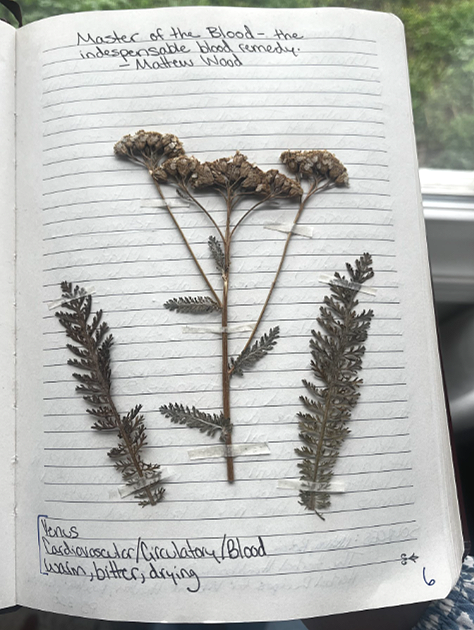
My Herbarium containing native herbs. Pressed Yarrow from the summer of 2025.
